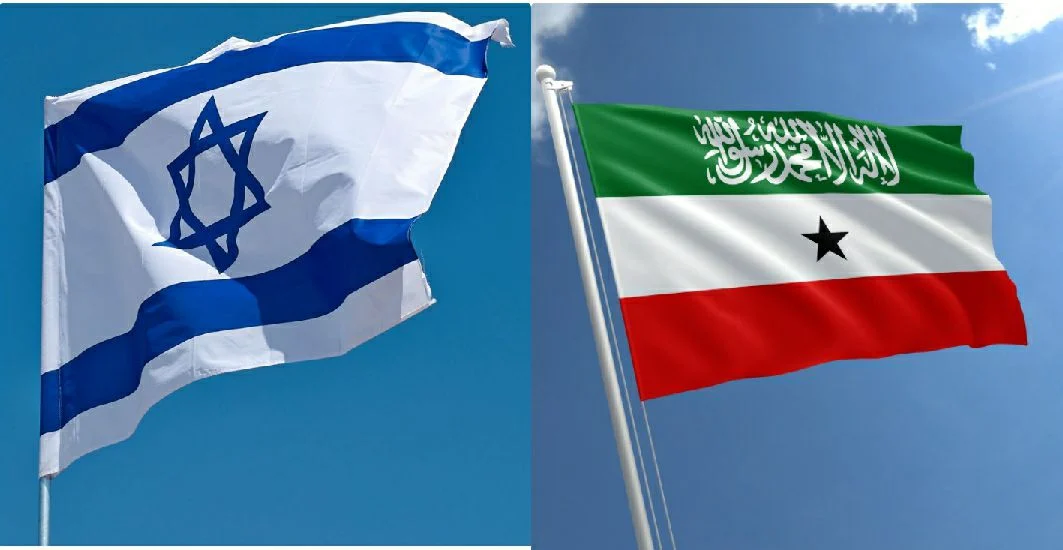
Israel flexes new diplomatic muscle in recognition of Somaliland
By extending diplomatic recognition to the breakaway statelet of Somaliland, Israel has cut a deal aimed at sharing intelligence and securing the strategic waterways of the Red Sea—making the country a player in the Horn of Africa, where Arab countries are jostling for influence.
Now Israel has a partner directly across the Gulf of Aden from territory in Yemen held by the Houthis, the militant group that has waged an armed campaign against Israel and ships passing through the Red Sea during the war in Gaza. The attacks snarled global shipping and turned the waterway into a smuggling hub.
Somaliland, a semidesert territory inside internationally recognized Somali borders, lies just south of the vital Bab al-Mandab Strait that connects the Red Sea to the Indian Ocean.
“No one can ignore the strategic location of Somaliland,” said Danny Danon, Israel’s ambassador to the United Nations in an interview. “The straits are a strategic point.”
The move, which drew widespread global condemnation, fits a wider Israeli objective: to establish itself on the diplomatic stage as a significant power honed by two years at war.
“Israel is less constrained by what others will say,” said Ofer Guterman, a senior researcher at the Tel Aviv-based Institute for National Security Studies. It is moving beyond military might to assert its power in the diplomatic field as well, Guterman added.
Israel has emerged from yearslong conflicts in Gaza, Lebanon and Iran emboldened as the dominant military power in the Middle East and less interested in compromise when it believes its security interests are at stake. Its recognition of Somaliland, a rare instance in which it has signed such an agreement with a Muslim-majority entity without public U.S. assistance, cements its newfound confidence in the international arena.
Somaliland has an underused port and a long runway at Berbera, and has shown a willingness to offer use of the facilities to countries in exchange for closer ties, though officials there said there were no plans to host an Israeli military base.
Still, the move makes Israel an important new variable in an area where a number of Arab countries are competing to hold sway.
Somaliland, which declared independence from Somalia during a civil war in 1991, is a self-declared nation of 6.2 million people—which, if it were a nation state, would be one of the poorest in the world. Its territory is smaller than Missouri.
Israel and the U.S. struck back against the Houthi attacks, which have abated since the cease-fire in Gaza, but didn’t manage to degrade the militants’ command structure in the way Israel took out the leadership of militant groups in Gaza and Lebanon over the past two years.
Houthi leader Abdul-Malik al-Houthi called the recognition a “hostile and illegitimate act” targeting Somalia, Yemen and the Red Sea and warned that any Israeli presence in Somaliland would be considered a military target.
Somaliland has in recent years been monitoring a Houthi buildup of arms trade and training to a Somali al Qaeda affiliate called al-Shabaab. The self-declared nation relies on tribal sources to gather information on the militants but lacks access to more high-tech reconnaissance and interception technologies of the type Israel could provide.
Weapons seizures in Somalia last year revealed that the Houthis were transferring arms to al-Shabaab and training the group to use sophisticated explosives and drones, a Yemen-focused United Nations report said in October. Western security officials fear the Yemeni faction could start staging attacks out of East Africa, effectively cornering shipping from both coastlines.
Somalia, which—though not populated by ethnic Arabs—is a member of the Arab League and one of only a few sub-Saharan African nations not to recognize Israel, sees the Israeli move as an unacceptable foreign interference.
Nations in the Middle East and Africa have largely operated under the understanding that to keep the peace they won’t redraw borders set since independence.
“It is Israel unilaterally advancing its own interests at the expense of others,” said Cameron Hudson, a former Africa director at the U.S. National Security Council, who warned that such a projection of power into the highly contested Horn of Africa could further destabilize the region.
sraeli officials have argued that their recognition of Somaliland is grounded in the fact that it has an effective democratic electoral system, with its own military and government acting independently from Somalia for decades.
Tammy Bruce, deputy representative of the U.S. to the U.N., argued before the Security Council that Israel had a right to conduct its own diplomacy and described Israel’s critics as hypocritical since many of them unilaterally recognized Palestinian statehood earlier in 2025 despite Israeli opposition.
Middle Eastern countries have long meddled in Africa, jostling for influence in the most strategic parts of the continent. Turkey, for example, provides military support to the central government in Somalia—which is at loggerheads with Somaliland and another of the country’s independent-minded entities, Puntland. The United Arab Emirates and Egypt back opposite sides in Sudan’s two-year civil war.
Cairo sees Israel’s recognition of Somaliland as a direct threat to its conflict over water with Ethiopia, say Egyptian officials. Egypt has been strengthening its alliance with Ethiopia’s neighbors to corner Addis Ababa and prepare for possible future confrontations. Last year, Egypt started positioning troops in Somalia as well as providing the African country with weapons and counterterrorism advisers.
In return for security cooperation, Somaliland hopes the recognition will inspire others to follow suit. The U.N. doesn’t recognize Somaliland’s independence.
Before Israel’s move, only Taiwan—which seeks international support for its autonomy from China—had diplomatic relations with Somaliland but stopped short of full recognition. A Somaliland attempt in 2024 to gain diplomatic ties with neighboring Ethiopiain exchange for a naval base failed when it faced a backlash from Somalia.
Israeli officials, however, appear unmoved by the international condemnation. “Spoiler alert: no one will determine for Israel whom it may conduct diplomatic relations with,” wrote Israeli Foreign Minister Gideon Sa’ar in a X post.
This article was published at Wall Street Journal