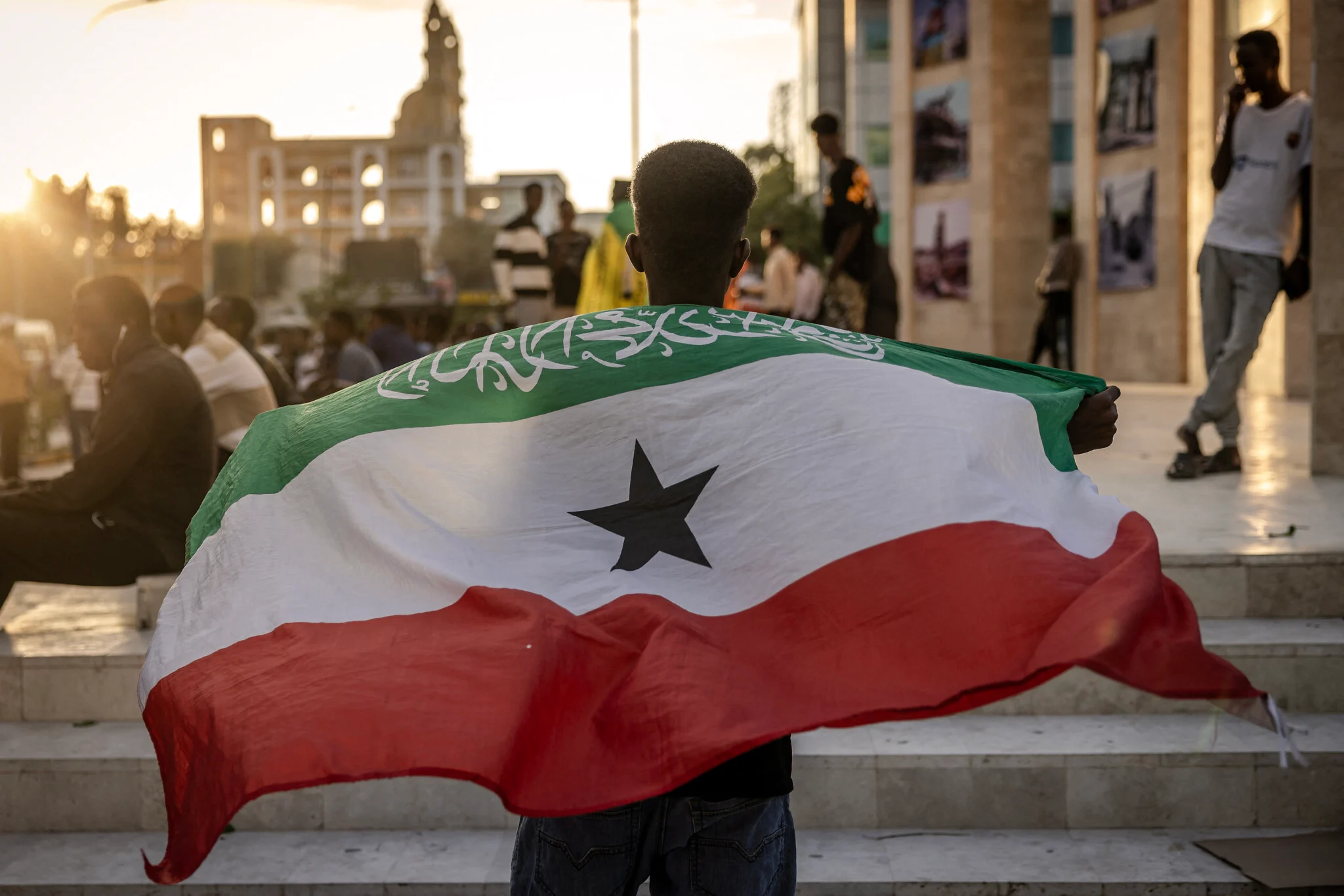
Israel Acts on Somaliland While the State Department Clings Fiction
Israel’s recognition of Somaliland is a strategic wager on performance over pretense. It rewards a functioning state in a volatile region and signals a hard-headed realism in the emerging Red Sea order. The move aligns diplomacy with governance reality: Somaliland delivers stability and security; Somalia remains mired in dependency, fragmentation, and chronic insecurity.
For decades, international diplomacy has treated Somalia as a unified, viable state with a functioning central government. In practice, it is not. The Mogadishu government survives on foreign troops and donor funding, while jihadist groups such as al-Shabab continue to control territory and terrorize civilians well beyond the capital.
Somaliland presents the opposite case. It governs its territory, secures its borders, and keeps jihadism at bay—without foreign forces on its soil. It legislates, taxes, enacts policies, and conducts, albeit imperfect, competitive elections. In every meaningful sense, it functions as a state. Yet it has been denied the recognition routinely granted to far weaker and more dysfunctional regimes.
The Bab el-Mandeb chokepoint, which links the Red Sea and the Gulf of Aden, carries approximately 15 percent of global seaborne trade, including vital flows of oil, gas, and grain. Houthi attacks, Iranian proxy activity, and great-power competition have transformed this corridor from a commercial artery into a frontline of global security.
Somaliland sits on 530 miles of the Gulf of Aden, one of the world’s most critical maritime chokepoints, with a long, stable coastline and the deep-water port of Berbera—upgraded through Emirati investment and positioned as a strategic alternative gateway to the Horn of Africa. For Israel, recognition unlocks cooperation in intelligence, maritime security, and trade, while reinforcing coordination with partners such as the UAE and Ethiopia, which favor a self-governing, pro-Western anchor on the southern flank of the Red Sea.
Regional powers condemning Israel’s decision are defending interests, not principles. Egypt views an empowered Somaliland through the prism of its rivalry with Ethiopia, and fears diminished leverage in Nile Basin politics. Turkey, which operates a military base in Mogadishu and has signed a one-sided agreement on oil, gas, and fishing with Somalia’s government, sees recognition as a direct threat to its political and economic position in Mogadishu.
China has poured billions into Djibouti, where it maintains its first overseas naval base, and is courting Eritrea as a strategic partner.
Moreover, Djibouti, heavily indebted to China and dependent on port fees and foreign military bases, views a rising Berbera as a challenge to its near monopoly on regional shipping and basing rights. Their objections are less about Somali “unity” than about protecting rents, influence, and bargaining power in a shifting Horn of Africa.
Mogadishu’s backers also argue that Israeli recognition of Somaliland would undermine international efforts to reconstitute Somalia and the fight against al-Shabab. But the fact is, lawlessness and chaos thrive in Somalia not because Israel recognized Somaliland, but because Somalia itself remains mired in dysfunction. By clinging to the fiction of “One-Somalia,” Washington risks ceding the Horn of Africa to authoritarian powers.
The African Union’s reflexive defense of colonial borders collapses under scrutiny in Somaliland’s case. The argument for Somaliland’s recognition is both legal and moral. Former British Somaliland achieved independence in June 1960 and was recognized by 35 states, including the United States and Israel. Only days later, it voluntarily united with the former UN-administered Italian territory of Somalia to form the Somali Republic. This union was never properly ratified and rapidly degenerated into authoritarian rule, repression, and ultimately state collapse.
In May 1991, Somalilanders restored their independence. An AU fact-finding mission in 2005 concluded that Somaliland’s case is “historically unique,” that the failed union inflicted grave injustice and suffering, and that addressing it would not open a Pandora’s box because Somaliland lies within its original colonial borders. In a 2001 constitutional referendum, Somalilanders overwhelmingly reaffirmed independence, standing for hours under the sun to legitimize a state they had already built from the ruins of war
On 26 December 2025, Prime Minister Benjamin Netanyahu formally announced Israel’s recognition of Somaliland as an independent and sovereign state, establishing full diplomatic relations and citing cooperation in agriculture, health, technology, and economic development.
This was not a sentimental gesture. It was a calculated decision to anchor a capable partner along a vital sea lane at a time of missile attacks on shipping and collapsing regional orders. For too long, the international system has rewarded dysfunction and punished performance—hiding behind outdated maps and UN memberships while ignoring real governance on the ground.
Israel chose a different metric. By recognizing Somaliland, it signaled that legitimacy flows from capacity: the ability to secure territory, protect citizens, safeguard trade routes, and deliver stability.
In a world where the Red Sea and Gulf of Aden are both a lifeline and a fault line, partners who deliver stability matter more than those who deliver speeches. That is why Israel recognized Somaliland—and why others are likely to follow.