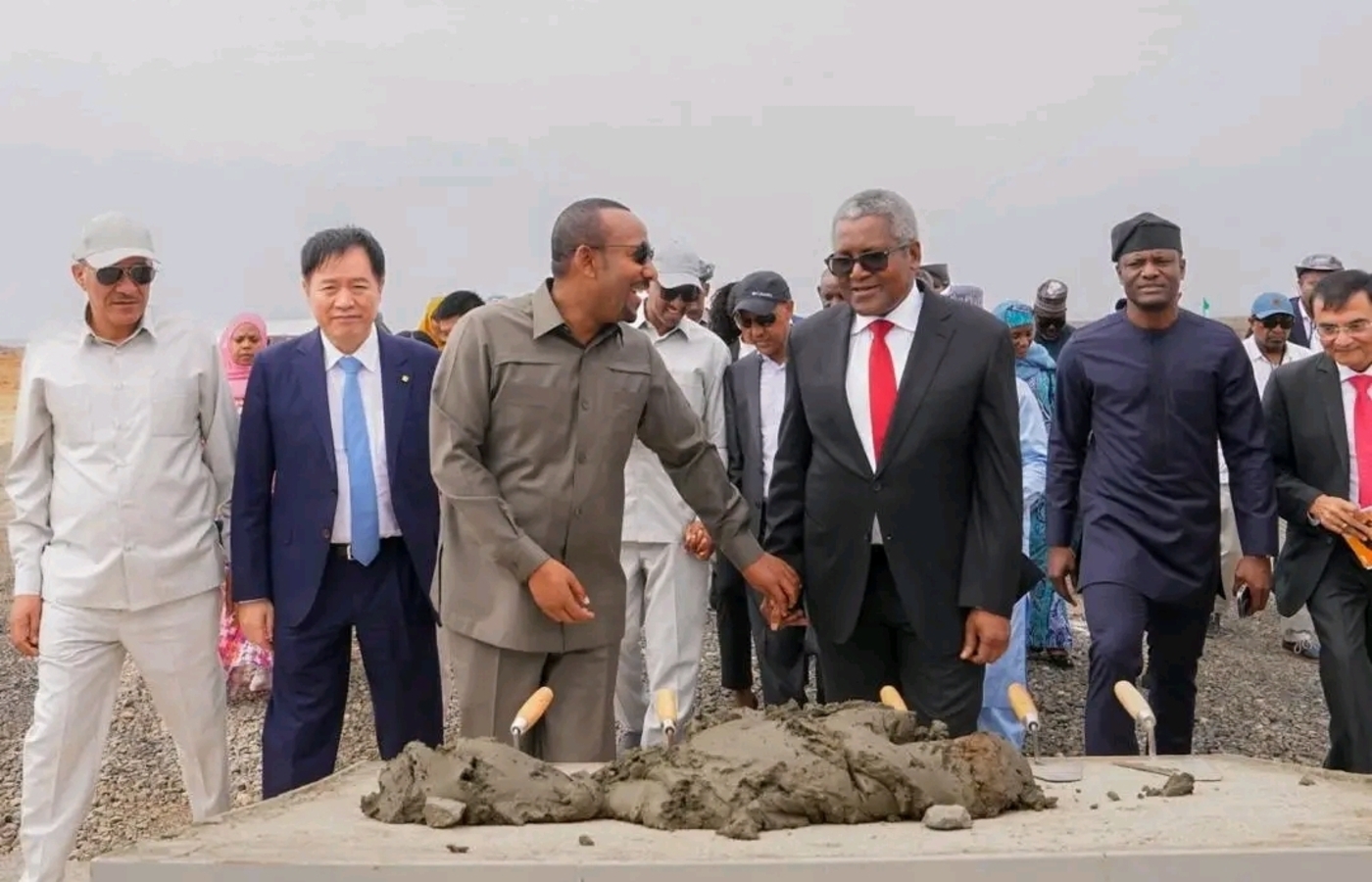
Ethiopia Bets Big on Fertilizer and Oil Refining: Dangote and GCL Anchor Mega Industrial Push
Ethiopia has taken another bold step in its industrialization drive, laying the foundation stones for two landmark projects that could redefine the country’s economic trajectory: a Urea Fertilizer Plant in partnership with Nigeria’s Dangote Group, and the Gode Refinery, spearheaded by China’s Golden Concord Group (GCL).
Unveiled by Prime Minister Abiy Ahmed (PhD) in a high-profile ceremony, the projects underscore Ethiopia’s determination to transform its vast natural gas and oil reserves into value-added industries, cut reliance on costly imports, and strengthen its bargaining position in regional trade.
The Fertilizer Gamble: Feeding Ethiopia’s Agricultural Future
Agriculture remains Ethiopia’s economic backbone, employing nearly 65% of the population and accounting for more than 30% of GDP. Yet, productivity has long been constrained by poor soil fertility and dependence on imported fertilizers.
The new Urea Fertilizer Plant, to be built by Ethiopian Investment Holding (EIH) and Dangote Group, promises a major leap:
- Annual capacity: 3 million tons of urea fertilizer.
- Feedstock: Natural gas extracted from the Kalub gas field.
- Pipeline: 108 kilometers linking Kalub to the plant.
Ethiopia currently spends over $1.5 billion annually on fertilizer imports, leaving it vulnerable to global price shocks. The war in Ukraine, which disrupted global nitrogen fertilizer supply chains, highlighted this dependency.
By producing at home, Ethiopia could not only save billions in foreign exchange but also stabilize input supplies for millions of smallholder farmers.
“This project is about more than fertilizer,” said an economist in Addis Ababa. “It’s about food security, fiscal stability, and Ethiopia’s ability to chart its own agricultural destiny.”
The Gode Refinery: Ethiopia’s Oil Awakening
For decades, Ethiopia’s hydrocarbon reserves in the Ogaden Basin were dismissed as “potential” due to insecurity, lack of infrastructure, and political instability. But the launch of the Gode Refinery marks a dramatic shift.
Built by China’s GCL Group, the refinery is expected to:
- Process: 3.5 million tons of crude oil annually.
- Source: Crude from the Hilala oil field in Somali Regional State.
- Output: Diesel, gasoline, and jet fuel for domestic use and regional export.
Currently, Ethiopia imports nearly 100% of its refined petroleum products, spending more than $3 billion annually—a major driver of forex shortages.
If successful, the refinery could transform Ethiopia into a net supplier of petroleum products to its neighbors, including Djibouti, South Sudan, and Somalia.
For the Somali Regional State—long associated with marginalization, conflict, and poverty—the refinery also carries symbolic weight as a harbinger of industrial inclusion.
Dangote Group – Africa’s Industrial Champion
- Founded by Aliko Dangote, Africa’s richest man, the conglomerate has already transformed Nigeria’s industrial landscape.
- The Dangote Refinery in Lagos, a $20 billion mega project, is set to make Nigeria self-sufficient in petroleum.
- Its entry into Ethiopia signals confidence in the country’s market scale and policy direction.
Golden Concord Group (GCL) – China’s Resource Powerhouse
- One of China’s largest clean energy and resource conglomerates.
- Has been active in Ethiopia’s oil and gas exploration since the mid-2010s.
- Bringing refinery expertise positions GCL as Ethiopia’s strategic Asian partner in hydrocarbons.
Together, Dangote and GCL represent Africa-Asia investment alignment, diversifying Ethiopia’s external partnerships beyond Western financiers and multilateral lenders.
Despite the optimism, the mega-projects face daunting challenges:
- Financing: Both fertilizer and refinery ventures require multi-billion-dollar capital injections. Ethiopia’s debt distress and ongoing IMF negotiations could complicate financing structures.
- Security: The Somali region remains volatile, raising concerns over pipeline and refinery protection.
- Infrastructure: Efficient logistics, power supply, and transport corridors are critical. Without them, production costs could soar.
- Environmental risks: Large-scale gas extraction and refining bring ecological challenges, from emissions to water contamination.
Ethiopia will need careful risk management frameworks—including guarantees for foreign investors—to avoid stalling momentum, as seen in earlier gas projects in Calub and Hilala.
Economic Impact: Billions in Savings and Jobs
- Foreign Exchange: Combined, the projects could save Ethiopia more than $4.5 billion annually in fertilizer and fuel import costs.
- Employment: Direct and indirect job creation could exceed 50,000 positions, especially in Somali and Afar regions.
- Industrial Linkages: Downstream industries, from transport to petrochemicals, stand to benefit.
Yet, experts caution that distribution networks—to farmers for fertilizer, and to consumers for fuel—must be modernized to ensure benefits reach end-users.
Geopolitical and Regional Stakes
Ethiopia’s move comes at a time when energy security is reshaping global politics.
- For the Horn of Africa, the refinery could reduce reliance on Gulf imports, giving Ethiopia and its neighbors strategic autonomy.
- For regional integration, Ethiopia’s fertilizer surplus could supply Kenya, Sudan, and Eritrea.
- For investors, success in Gode could open Ethiopia’s 120-trillion-cubic-foot gas reserves to further development.
Some analysts see these projects as part of Abiy’s bid to anchor his legacy in industrial transformation, much like the Grand Ethiopian Renaissance Dam (GERD) became a symbol of national ambition.
Unity Through Development
In his speech, Prime Minister Abiy framed the projects as nation-building tools, not just industrial assets.
“These projects are more than just industrial infrastructure,” Abiy said. “They reflect our shared responsibility to elevate Ethiopia’s place on the world stage in a way that honors the true spirit of Ethiopian identity.”
By calling for unity and solidarity, Abiy tied economic modernization directly to Ethiopia’s political and cultural identity, echoing past development megaprojects used to mobilize national pride.
Outlook: Promise and Peril
If completed on schedule, the fertilizer and refinery projects could stand alongside the GERD as symbols of Ethiopia’s developmental state model.
But the path forward is uncertain:
- Will investors stay the course amid forex shortages?
- Can security be guaranteed in Ethiopia’s east?
- Will the benefits trickle down to farmers and consumers—or remain trapped in elite and investor circles?
The answers will determine whether Ethiopia’s “double foundation” becomes a launchpad for prosperity—or another unfinished dream in the nation’s long quest for industrial transformation.
Sidebar: Ethiopia’s Energy and Fertilizer Snapshot
| Indicator | Current Status | Post-Project Projection |
|---|---|---|
| Fertilizer Imports | $1.5B annually | Reduced by 80–90% |
| Petroleum Imports | $3B annually | Cut by up to 60% |
| Fertilizer Production | <0.5M tons | 3M tons |
| Oil Refining Capacity | 0 | 3.5M tons |
| Jobs Created | Minimal | 50,000+ |
Bottom Line
Ethiopia is placing its bets on fertilizer and fuel as the next frontier of its industrial revolution. With Dangote’s African pedigree and GCL’s Chinese capital, the projects carry the weight of promise.
But their success will hinge on financing, security, and governance—areas where Ethiopia has stumbled before.
For now, the foundation stones in Gode and Kalub represent both hope and risk. Ethiopia stands at a crossroads: either to cement its place as an emerging industrial power in Africa, or to repeat the cycle of ambitious but stalled resource projects.
This article was originally published at Addis Insight